The Drum Module 66 (DM66) is a Eurorack 5-voice vintage analog drum generator, inspired by DIY and pro drum machines from the 1960s.
Description
The DM66 recreates the cheesy sounds of early drum machines. The sounds are quite simple, but have a lot of character.
Each voice is triggered by an individual gate signal, and each voice has its own individual output.
The Mix output combines all 5 voices.
Gate signals should be 0-5V. However, other voltage ranges are tolerated and can produce slight variations in the sound.
The voices have an amplitude of about 4Vpp.
In details
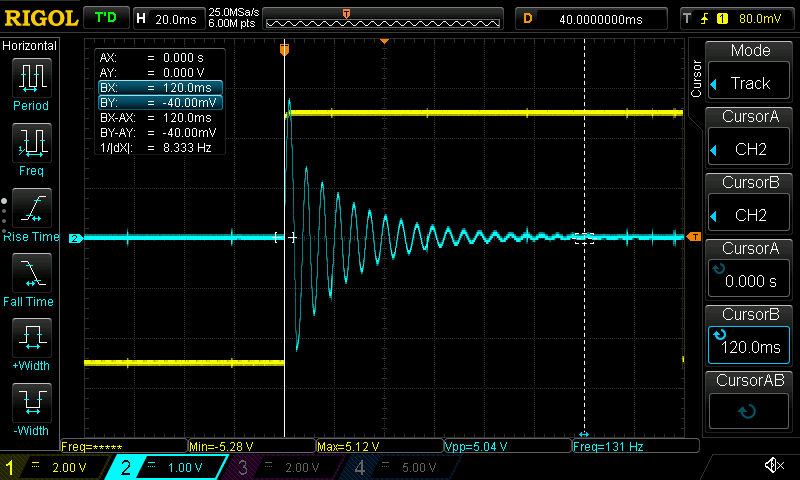
The 5 voices of the DM66 are based on damped Twin-T oscillators. This technique was very common in analog drum machines.
The frequency and duration of each voice are set by a combination of resistors and capacitors.
Component value changes
Version 0.2
The BOM and PCB contain several important errata, all located in the Mix section (schematics page 8):
- R61, R65, R75 and R79 should be 100kΩ (were incorrectly listed as 10k on the silkscreen).
Assembly guide
Start by soldering the smallest components first, then proceed to progressively larger/taller ones.
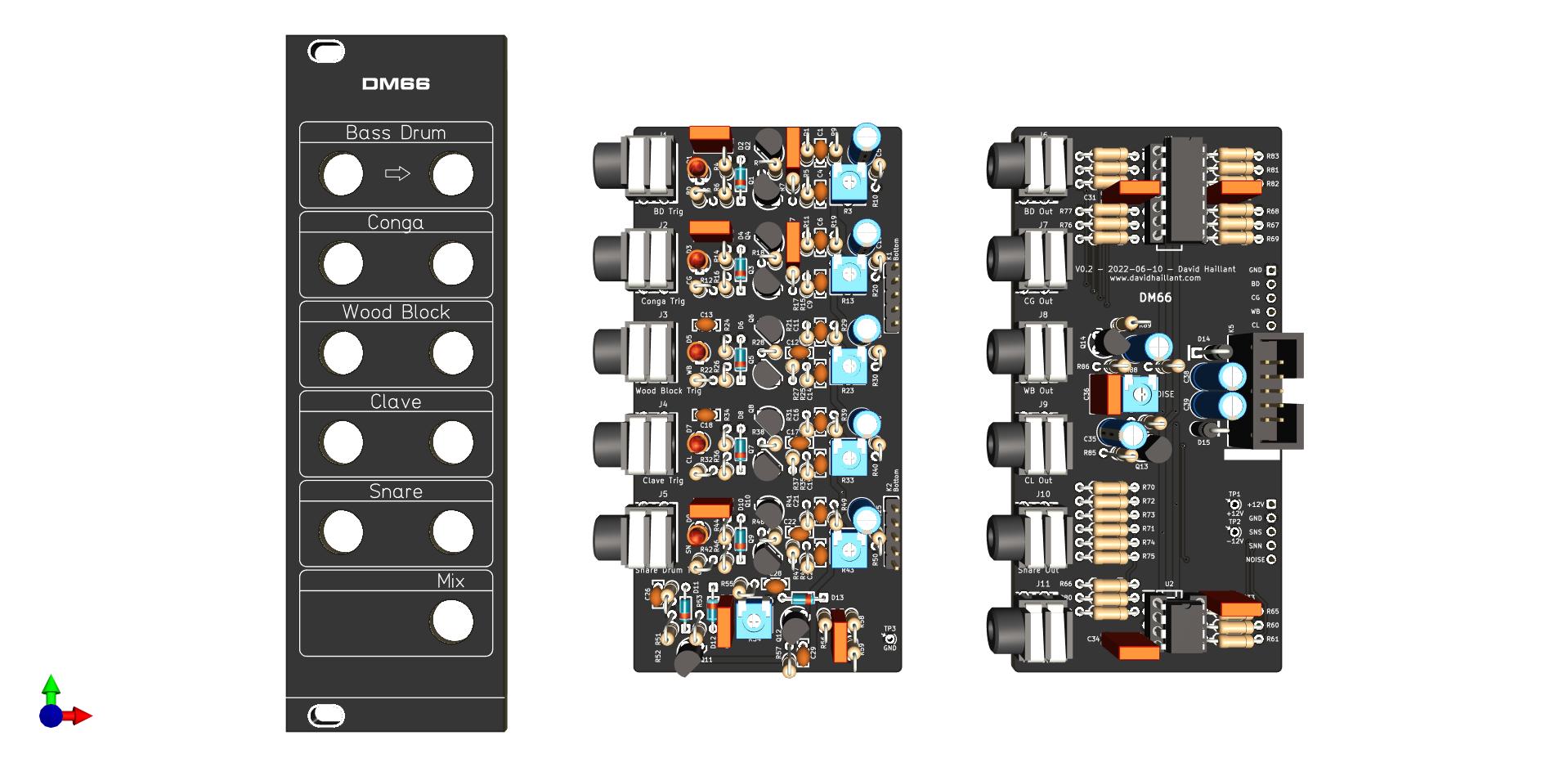
Bottom Board
The bottom board is particularly crowded.
All resistors are mounted vertically (one leg straight, the other bent 180°). Be gentle when bending the leads, and do not pinch them.
B1 and B2 (ferrite beads) are not used and can be left unpopulated.
Calibration and first tests
Each voice has a trim potentiometer that sets the damping of its oscillator. It modifies both the duration and the frequency of the oscillation.
In extreme positions, the voice will either fail to resonate, or self-oscillate. Adjust to your liking.
Hi, David!
Do you have any of these DM66 boards and panels available for sale?
I would love to get my hands on a set of one, if possible please.
Tanks for your interesting project
Hi David
I try to built your DM66 and need to know what is the value of C35. You just say its „CP“
But whats CP ? I dont know and dont understand ist. Maybe you can help me
Best regards
Thomas
Hello Thomas,
Oops, “CP” isn’t very useful indeed 🙂
(“CP” stands for Capacitor-Polarized.)
That part of the circuit is a copy of the noise source from the TR606. The same circuit is also used in my 606 Toms clone, and there, I use 47µF.
The value isn’t critical though. Anything between 10~100µF should be fine.